Have you ever noticed how a small patch of shade can affect the power of an entire solar system? You might wonder why a few leaves, a vent, or a chimney shadow can cause your panels to lose so much output.
You may have even heard that bypass diodes solve this problem. But what do they do?
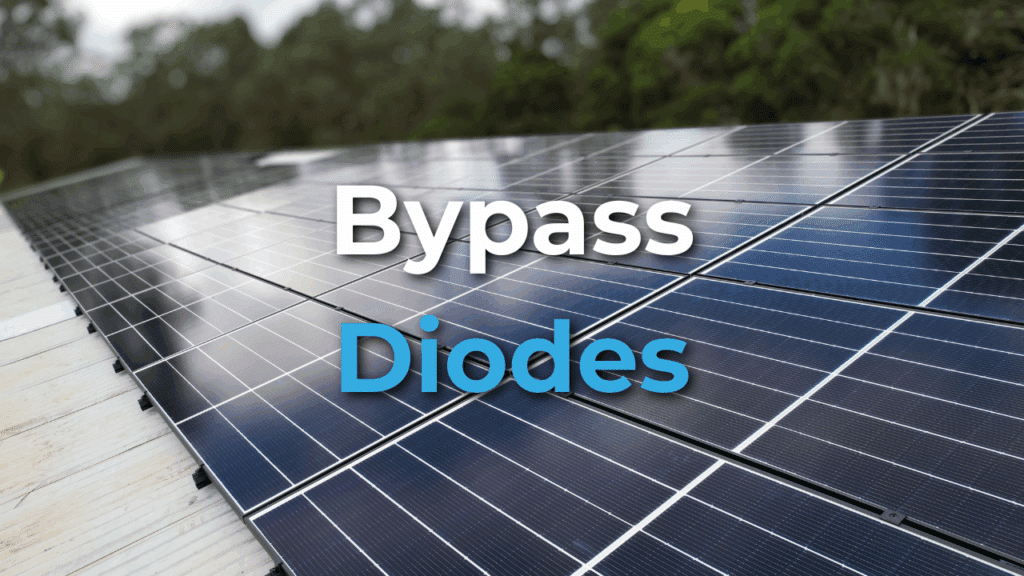
At PSC Energy, we like to debunk some of the myths and misconceptions about solar. Many homeowners believe bypass diodes increase performance when shade hits a panel. They do not. They protect the panel. They help it work safely under challenging conditions, but they do not make the shaded cells produce power.
In this article, you’ll learn about the following:
- What Is a Bypass Diode?
- What Bypass Diodes Do and Don’t Do
- FAQ: Bypass Diodes
By the end of this article, you will learn what bypass diodes are, how they work, what they protect, and how they affect your system’s performance over time.
What Is a Bypass Diode?
A bypass diode is a small, one-way electrical device built into every solar panel. It acts like a valve that lets electricity flow in one direction but not the other. You cannot see it on the front of your panel because it sits on the back.
Inside each solar panel, dozens of individual solar cells are wired in series. This means that electricity flows through one cell, then the next, and so on, all the way across the panel.
If one of those cells is shaded, it becomes a weak point in the chain.
A bypass diode provides a shortcut for the current around the shaded group of cells.
- Without it, the shaded cells could heat up and get damaged.
- With it, the current can still flow safely through the rest of the panel.
You lose some power, but you save the panel from overheating.
How a Solar Panel Is Wired
To understand bypass diodes, it helps to know how a panel is built. Every panel contains rows of solar cells. These cells work together to form what’s called a “string” inside the panel.
Most modern solar panels have three substrings. Each substring contains a section of cells. Every substring connects to one bypass diode. The diodes sit across those sections like safety bridges. When the entire panel is in sunlight, the current flows smoothly through all three substrings, and the diodes remain off.
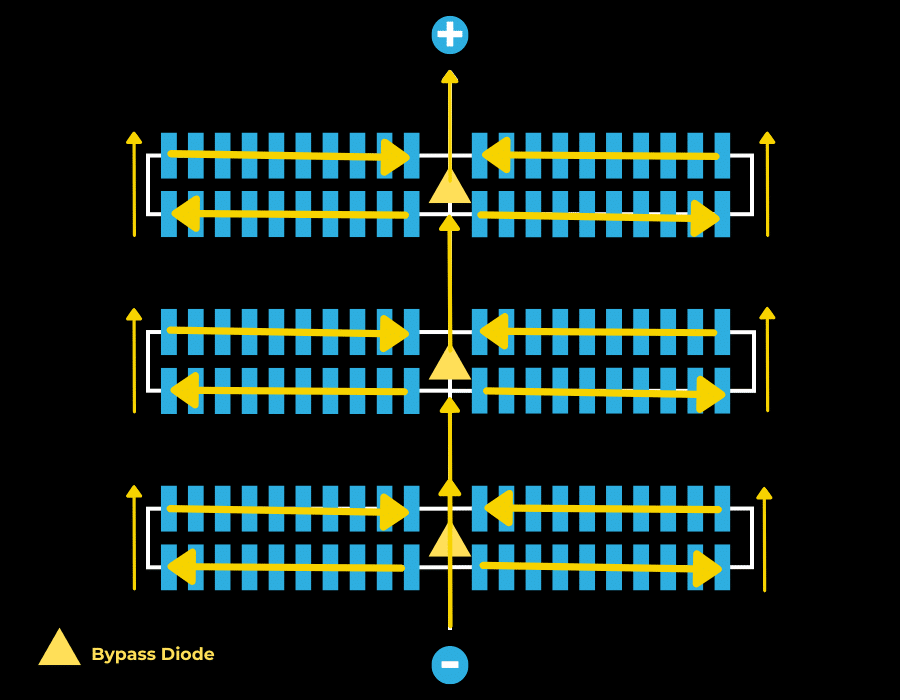
If shade hits one substring, the bypass diode for that section switches on. It allows the current to skip that shaded part. Electricity still flows through the other substrings that are in the sun.
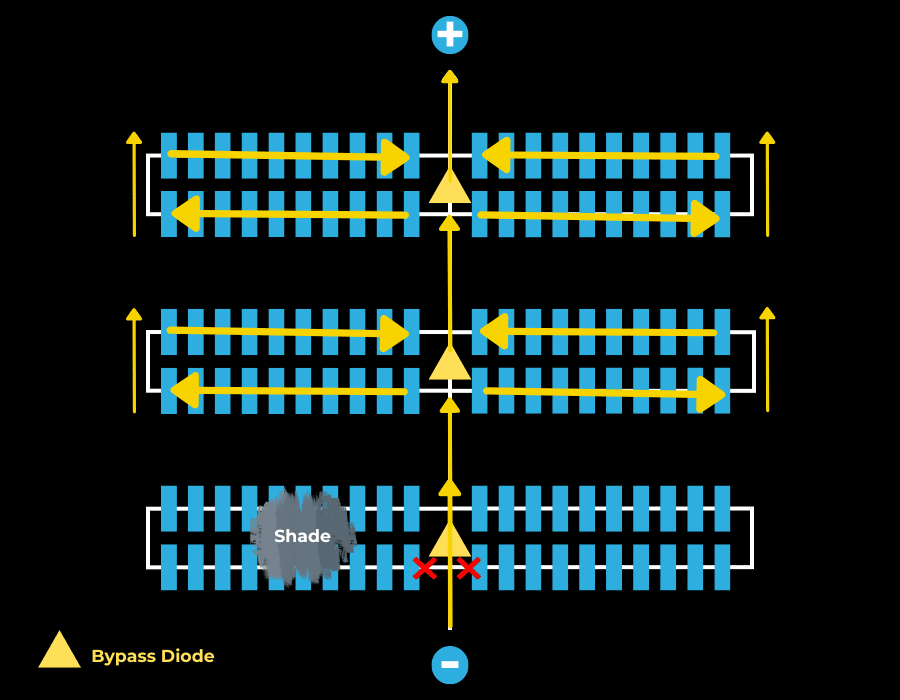
You can think of each substring as a lane on a motorway. If a fallen branch blocks one lane, the bypass diode acts like a slip lane, allowing traffic to bypass it. The flow slows a little but does not stop completely.
Why Solar Panels Need Bypass Diodes
Solar cells are like one-way valves for electricity. They generate current when light hits them, but when shade falls across them, they can be pushed in the opposite direction. This condition is called reverse bias.
A reverse bias harms solar cells by causing them to heat up. When that happens, small areas of the panel can reach high temperatures, forming hot spots.
Hot spots can cause permanent damage to the panel and reduce its lifespan.
Bypass diodes prevent that problem. They open a low-resistance path around the shaded section so the current does not force its way through the shaded cells. This keeps the panel safe, reduces heat, and maintains steady operation for the rest of the system.
What Happens When a Bypass Diode Turns On
When a bypass diode turns on, it allows current to flow around the shaded cells instead of through them. The diode becomes a temporary bridge. This keeps the voltage of that substring near zero while the other substrings continue to produce normally.
Let’s say one-third of a panel is shaded by a chimney. That shaded section has a bypass diode across it. When the diode turns on, the voltage from that section drops out, but the rest of the panel continues to contribute power. You lose roughly one-third of the panel’s power for as long as the shadow sits there.
When the shadow moves away, light returns to the cells, and the diode switches off again. The panel automatically returns to full output. This process happens in fractions of a second, without any control systems or external electronics. It is entirely built into the panel.
How Many Bypass Diodes Are in a Panel
Most grid-connected panels today have three bypass diodes, one for each substring. A typical half-cut cell panel consists of 120 half-cells, grouped into six half-substrings that pair under three diodes.
The number of diodes is not the only thing that matters. The quality of the diodes, the way the substrings are arranged, and the panel’s internal wiring design all affect performance and durability. A panel with cheap diodes or a poor layout can fail faster, even if it has the same count as a premium panel.
If you’re interested in learning a bit more about bypass diodes and panel-level electronics, you might want to check out the following article titled, Do You Need Microinverters If You Have Bypass Diodes on Your Solar Panels?
What Bypass Diodes Do and Don’t Do
Bypass diodes do several important jobs that protect both your panels and your system.
- They protect cells from reverse bias and hot spots.
- They let electricity flow around shaded sections.
- They reduce the performance loss caused by localised shade.
- They keep the rest of the panel producing power while part of it is shaded.
- They improve reliability and safety across the entire string.
In short, bypass diodes prevent a small problem from becoming a big one. They give your panels resilience against the everyday realities of shade, dirt, and debris.
What Bypass Diodes Do Not Do
Bypass diodes cannot perform miracles.
- They cannot make shaded cells produce energy.
- They do not erase the effects of shade.
- They do not increase the total output of your system.
- They are a safety feature, not a performance booster.
They also do not replace good system design. You still need to avoid regular, heavy shading where possible. Smart design ensures that panels with shade are not linked to panels in full sun on the same string.
Bypass diodes are there to protect, not to optimise. If you want every panel to work independently under moving shade, you need devices such as power optimisers or microinverters. Those technologies do a different job.
Bypass Diodes vs Panel-Level Power Electronics
Bypass diodes and panel-level electronics often get mixed up, but they do different things.
Bypass diodes are built into the panel and protect small sections inside it. They are automatic, simple, and passive. They stop hot spots and reduce small shade losses.
Power optimisers and microinverters sit outside the panel. They manage power at each solar panel. They improve performance when shade moves from one panel to another and provide monitoring data.
You can think of it like this: the bypass diode keeps the panel safe, while the optimiser or microinverter keeps the system efficient under complex shading.
Why Premium Panels Handle Shade Better
Premium panels like AIKO use advanced engineering to handle shade in ways that most panels cannot. Their design focuses on consistent power, strong protection, and long-term reliability.
Here’s how AIKO panels manage shade so effectively:
- Each AIKO solar cell can act as its own bypass diode.
- This cell-level protection allows current to flow smoothly around shaded areas.
- It prevents energy bottlenecks that can cause hot spots or damage.
- It maintains balanced voltage and current across the panel, even under partial shade.
- The panel still includes traditional high-quality bypass diodes in the junction box for added safety.
Because the cells themselves can bypass shaded sections, AIKO panels respond more quickly and efficiently to changing conditions. The current does not have to travel through a single diode pathway; instead, the cells adjust dynamically within the panel.
This design means that when shade moves across the roof, the panel behaves predictably. It stays safe, maintains steady output, and returns to full performance as soon as light comes back. That reliability is what sets premium panels apart. It is not magic. It is clever engineering built to deliver real-world performance on real Australian roofs.
If you’re interested in learning a bit more about AIKO solar panels, you might want to check out the following article titled, Everything You Need to Know About Aiko Neostar N-Type ABC All Black Solar Panels.
Bypass Diodes Get Around Shady Characters
Now you know the ins and outs of how bypass diodes work in your solar panels. They aren’t intended to optimise your system; they’re a safety feature in solar panels.
If you want to know how shading affects your roof, click the button below. At PSC Energy, our design team will show you how each panel would perform and how to plan for long-term reliability.
You will see how bypass diodes, smart design, and premium panels work together to keep your system safe, stable, and productive for decades. It’s what we do.

If you’re interested in learning a bit more about solar panels and energy systems, you might want to check out the following article titled, Are Solar Panels Worth It in NSW, Australia? A Price Breakdown for 2025.
Frequently Asked Questions About Bypass Diodes
What is a bypass diode in a solar panel?
A bypass diode is a small electronic component inside the solar panel. It lets electricity flow around a shaded or damaged group of cells so the rest of the panel can keep producing power. It protects the panel from overheating and prevents hot spots that could reduce its lifespan.
How do bypass diodes work?
Bypass diodes act like one-way valves. When sunlight reaches every cell, electricity flows normally. When shade covers part of the panel, the diode switches on, providing a new path for the current around that shaded section. This keeps energy safely flowing through the rest of the panel and prevents power loss across the whole string.
Why are bypass diodes important?
Bypass diodes protect solar panels from damage caused by shade or dirt. Without them, shaded cells can heat up, form hot spots, and shorten panel life. With them, panels stay safe and continue producing steady power even when part of the panel is shaded.
Do bypass diodes increase solar output?
No. Bypass diodes do not boost output. They only reduce power loss and protect the panel when shade appears. They act like seat belts, not accelerators; they keep your panels safe, but they don’t produce extra energy.
Do all solar panels have bypass diodes?
Yes, all modern grid-connected solar panels include bypass diodes. Most panels have three, one for each substring of cells. Older or very low-cost off-grid modules may differ, but every reputable manufacturer includes them for protection.
How many bypass diodes are in a solar panel?
Most standard solar panels have three bypass diodes, one for each section of cells inside the panel. Larger panels and half-cut cell models still follow the same principle, though layouts may vary slightly.
Can bypass diodes fix shade problems?
Bypass diodes cannot eliminate shading losses. They only protect the panel and keep the rest of the system producing. Good system design, correct panel placement, and sometimes panel-level devices such as microinverters or optimisers are needed to manage heavy or moving shade.
What happens if a bypass diode fails?
If a bypass diode fails open, the shaded section of the panel can overheat and form a hot spot. If it fails short, that section stops producing power even in full sunlight. You may see reduced output in monitoring data. The fix is usually to replace the affected panel under warranty.