Updated on November 4, 2025
Have you ever found yourself engaged by a wonderful piece of content about microinverters only to read the comments and see someone say that they’re not necessary if you have bypass diodes on your solar panels?
At PSC Energy, we understand the complexities of solar energy systems and aim to provide clarity on topics like this one. With years of experience in the solar industry, our team of electricians possess an in-depth understanding and hands-on experience with solar technologies, including microinverters, solar panels, and bypass diodes.
We’ve helped countless customers figure out their unique energy needs and goals.
In this article, you will learn the following:
- How Does Shade Affect Your Solar Panels?
- What is a Bypass Diode on a Solar Panel?
- Do Bypass Diodes Ever Fail?
- How Are Bypass Diodes Different from Microinverters?
Let’s dive in!
How Does Shade Affect Your Solar Panels?
Shade blocks solar panels from sunshine. This problem exists on a spectrum between soft and hard shading.
Soft shading happens when faraway objects, like clouds, partially block sunlight from your solar panels. The shadow has no real discernible edge to it.
When it’s cloudy, some sunlight still reaches your panels, allowing for a bit of power generation. Not much though. They still block sunlight and affect the performance of your solar panels.
Hard shading occurs when solid objects near the panel block sunlight. Examples include chimneys, debris, telephone wires, and trees.
Power loss in a solar panel is proportional to how much sunlight is blocking it. Solar panels can’t produce power if sun is no longer shining on them.
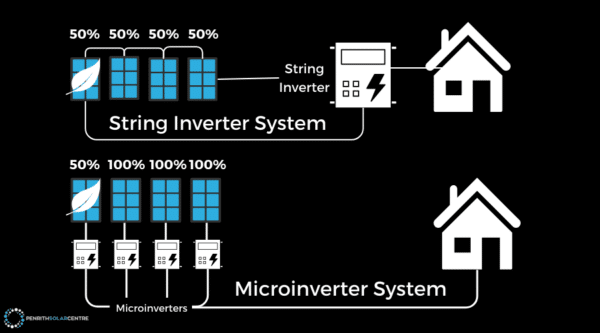
Shading makes a huge difference in how a solar system works. It’s a big problem for a system with a string inverter where a drop in output from one solar panel will affect the rest of that “string.”
If you clicked on this article, you probably already know what a microinverter is, how it works, and how it’s unbothered by shade.
If you’re interested in learning a bit more about the relationship between shade and solar panels, you might want to check out the following article titled, Myths & Misconceptions About Solar Microinverters.
What is a Bypass Diode on a Solar Panel?
Bypass diodes sit inside a solar panel to protect cells when part of the panel is shaded or not working. Their job is to keep heat from building up in a small area, which is what people call a hotspot.
- A bypass diode turns on when a group of cells cannot pass current normally.
- It gives the current a safe path around the problem area.
- This reduces heat and helps the rest of the panel keep working.
Solar panels are made of many small solar cells. Each cell makes about 0.5 to 0.6 volts in sunlight. You can think of a solar cell as the opposite of an LED. An LED uses electricity to make light. A solar cell uses light to make electricity.
- Cells in a panel are wired in series so their voltages add up.
- Electricity follows the path of least resistance, similar to water.
- If a cell is shaded or fails, it can block current and create heat; the bypass diode limits that effect.
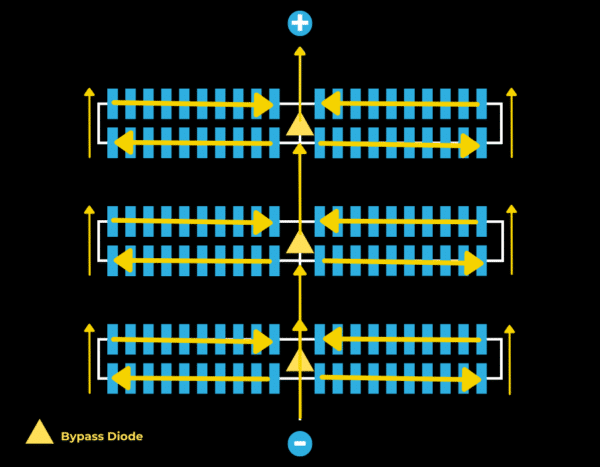
Most common panels have 60 to 66 full-size cells, and many modern panels use 120 half-cut cells. There are not enough diodes for each cell. Panels usually include three bypass diodes. Each diode protects roughly one-third of the panel.
In a 120 half-cut design, wiring changes the layout, but each diode still protects about one-third of the panel.
In a 60-cell panel, each diode typically covers a substring of about 20 cells.
In a 66-cell panel, each diode typically covers about 22 cells.
These substrings within the panel look like this:
Shaded cells can’t make as much power as unshaded cells because there’s a shadow between the cell and the sun. Makes sense, right?
Pushing current through a shaded cell makes the voltage become negative. The cell uses power instead of making it. Why is that?
A solar cell goes into “reverse bias voltage,” where the flow stops and the cell turns current from other cells into heat, creating a hotspot. Hotspots can lead to burnouts, faster degradation, and cell/glass cracking.
The bypass diode will send the current around the affected substring (one-third of the panel) so the cells that stopped outputting power don’t drain the life out of the others.
The current bypasses the affected area on the panel.
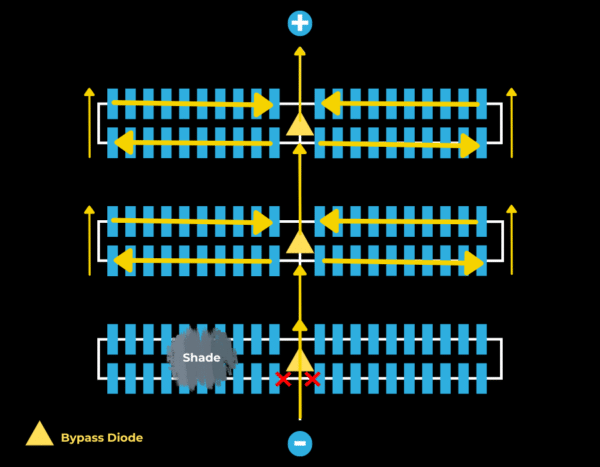
Many think that bypass diodes are also intended to reduce power loss in shaded solar installations the way microinverters do.
This is not true. Panels have bypass diodes to prevent hotspots They are not designed or intended to maximise the efficiency of your solar panels.
Bypass diodes can’t do anything other than bypass underperforming substrings. Panels in a string inverter system will all be affected by the underperforming panel.
We love the following graphic and draw it like a gun every chance we get. It’s that necessary. Here it is again:
If you’re interested in learning a bit more about solar panels and energy systems, you might want to check out the following article titled, Are Solar Panels Worth It in NSW, Australia? A Price Breakdown for 2025.
Do Bypass Diodes Ever Fail?
Bypass diodes can fail when they work too hard. When a diode turns on to bypass shaded cells, some of the energy turns into heat. Repeated shading can build heat and stress the part over time.
- Voltage surges can exceed a diode’s rating and cause failure.
- Moisture inside a panel can short a diode.
- Manufacturing defects happen. A good product warranty should cover that.
You can spot failed diodes with thermal imaging. A technician can scan the array and find hot spots that point to a bad diode. This is a common diagnostic step during service calls.
- Panel-level monitoring can flag an underperforming module.
- A drop of about one-third in a panel’s output often points to one bypass diode conducting or failing, since most panels use three diodes. Exact thresholds depend on the panel and the monitoring platform.
If you use Enphase microinverters, the Enlighten app makes it easy to see panel-level performance. Other brands with panel-level monitoring can show similar dips. The key is that you can see one panel lag the rest and act on it quickly.
If testing confirms a faulty diode within the panel, your installer can guide a warranty claim or panel replacement.
If you see a sustained drop on one panel, contact your installer to confirm the cause.
Keep trees trimmed and remove repeat shading where practical to reduce diode stress.
Your solar installer will lodge a warranty claim and have that panel replaced.
The panels still have bypass diodes in them. They didn’t prevent the other panels in the string from dropping the way they always do in a string system when it’s shaded.
If you’re interested in learning a bit more about weighing the cost of solar against the cost of the grid, you might want to check out the following article titled, Cost of Solar Panels vs. Cost of Energy from the Grid.
How Are Bypass Diodes Different from Microinverters?
Bypass diodes protect panels, but they do not maximise energy. To get higher efficiency, you need control systems that set the best voltage and current.
- A string inverter with MPPT scans the whole string and picks the best operating point.
- Microinverters or DC optimisers run MPPT for each panel on its own.
- Both approaches aim to keep the array close to peak power as light and temperature change.
Bypass diodes are not a substitute for panel-level optimisation. They act like safety valves that route current around stressed cells and limit hotspots.
- Panel-level MPPT lets a shaded panel run at its own best point without pulling the rest down.
- Adjusting a shaded panel’s voltage and current can reduce diode activation and cut heat loss.
- Real gains depend on shade patterns, roof layout, and the limits of the hardware.
Shade still reduces energy, but panel-level gear can limit the impact and improve fault finding. A quality string inverter performs well on unshaded arrays and simple roofs. Choose the approach that fits your site conditions and goals.
In that spirit, if you’re interested in reading up about the differences between the often-mentioned microinverters and DC optimisers, you might want to check out the following article titled, Microinverters vs. DC Optimisers: Which Is Better?
Cross My Heart and Hope to Diode
Now you know what bypass diodes are, and how they behave. They are a component that is relied upon in string solar systems to prevent the panels from getting hotspots. And unfortunately, they are limited by the same limitations of a string solar system.
If you want to maximise your solar production, you should consider investing in a system that has panel-level optimisation like a microinverter solar system or a string system with DC optimisers.
At PSC Energy, we’re focused on educating solar enthusiasts in this booming market. We’re educators first and feel it’s important to empower our customers with information.
If you’re interested in learning a bit more about solar and battery rebates in NSW, Australia, you might want to check out the following article titled, Ultimate Guide to Australia’s 2025 Solar Rebate and Battery Rebate: Federal and NSW Rebate for Solar.
FAQ: Bypass Diodes
Are microinverters necessary if my solar panels have bypass diodes?
Bypass diodes do not replace microinverters. Diodes protect panels from hotspots. Microinverters optimise energy on each panel. If you want higher yield in shade and panel-level control, you still need microinverters.
What does a bypass diode do on a solar panel?
A bypass diode lets current flow around a weak section of a panel. It prevents reverse bias and hotspots. It does not boost output. It only protects the panel from damage.
How many bypass diodes are in a typical solar panel?
Most panels have three bypass diodes. Each diode protects one substring, which is about one-third of the panel. On a 60-cell panel, each diode usually covers about 20 cells. On 120 half-cut cells, each diode still covers about a third of the panel.
How does shade affect solar panels?
Shade lowers light on the cells. Less light means less current. In a string system, one shaded panel drags down the whole string. In a microinverter system, only the shaded panel drops.
Do bypass diodes improve energy in shade?
No. Diodes are not an efficiency feature. When a substring is shaded, the diode turns that third “off” to stop damage. You lose about one-third of that panel’s output while the diode conducts.
What is reverse bias and why does it matter?
When a shaded cell is forced to pass current from brighter cells, its voltage goes negative. That is reverse bias. The cell heats up and can form a hotspot. Hotspots speed up degradation and can crack cells or glass.
What is a hotspot on a solar panel?
A hotspot is a local high-temperature area on a cell. It forms when current is pushed through a shaded or faulty cell. Hotspots reduce life and can cause visible burn marks.
When do bypass diodes turn on?
They conduct when a substring becomes the weak path, such as under hard shade or a cell fault. The diode gives current a safer path around that substring.
How can I spot a blown bypass diode?
Thermal imaging shows hot areas on a panel. With panel-level monitoring, you will often see a steady one-third drop from that module. In apps like Enphase Enlighten, a 33% drop is a strong clue.
What happens to a string if one panel’s diode blows?
That panel may be stuck at two-thirds output. The entire string then falls toward the lowest performer. Your whole array can run at the level of the weak panel.
Do microinverters remove the need for bypass diodes?
No. Panels still include diodes for protection. Microinverters reduce how often diodes need to conduct because they set the best operating point per panel. That keeps shaded panels from dragging others down.
How do microinverters handle shade differently?
Each panel has its own inverter and Maximum Power Point Tracking (MPPT). The shaded panel finds its best voltage and current. The bright panels keep working near their best point. Your system loses far less energy.
What about DC optimisers—are they the same as microinverters?
DC optimisers also work at panel level, but they keep power in DC and feed a central inverter. They reduce mismatch like microinverters do. Microinverters convert to AC at the panel.
Which gives better fault detection: bypass diodes or microinverters?
Bypass diodes do not detect faults. They only react. Microinverters (and DC optimisers) provide panel-level data. You can see shading, dirt, or a failing substring early and act fast.
What are common causes of bypass diode failure?
Thermal stress from frequent shading, voltage spikes, moisture ingress, and manufacturing defects. Poor installation quality that raises operating temperatures can make it worse.
Will microinverters help with dirt, leaves, or bird droppings?
Yes. Localised soiling affects only that panel’s output. Other panels keep producing near their best. With a string inverter, one dirty panel can pull down the string.
What should I do if I suspect a blown bypass diode?
Log the performance drop, take photos of any visible marks, and contact your installer. With panel-level monitoring, share the affected panel’s data. A warranty claim usually covers a faulty panel.