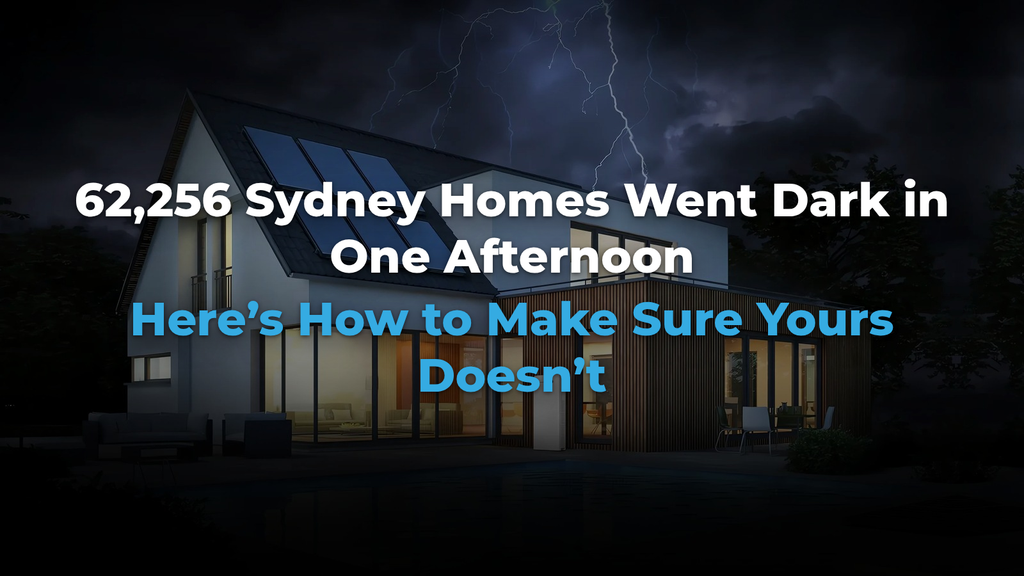
On 5 September 2026, a single afternoon of gale-force winds left 62,256 homes across Greater Sydney without power. Crews found faults at more than 250 sites. A Total Fire Ban was in force, which locked out the network’s automatic restoration systems and forced every fault to be checked by hand. That is why the outage ran so long.
PSC Energy has installed solar and batteries across Western Sydney and the Blue Mountains for over a decade, so our phones ran hot that week. Almost every caller asked a version of the same question. “I have solar on my roof, so why did I lose power like everyone else?”
The answer catches people off guard, and it is the most useful thing you can learn before you spend a cent on backup. In this article you will find out why your panels switched off, what a battery actually changes, and the one question that tells you whether a backup quote is worth signing.
Why Your Solar Panels Switched Off Too
Your panels did not fail, and your installer did not cut a corner. Australian law requires every grid-connected solar inverter to shut down the moment it detects a blackout. The feature is called anti-islanding.
The logic is about keeping people alive. When a line worker repairs a fallen powerline, they need to know that line is dead. If your panels kept pushing electricity into the network, the line would be live and nobody would have warned them.
So the size of your system makes no difference. A 3kW system and a 15kW system both give your home nothing during an outage. Full sun changes nothing. The only thing that changes the outcome is a battery paired with an inverter built for backup.
The full explanation: Will Your Solar Panels Work During a Blackout? →
What a Battery Actually Changes
A backup-capable system reacts faster than you can notice. Your inverter sees the grid drop, the system disconnects your home from the network so nothing feeds back into it, and the battery picks up your load. Good systems manage this in milliseconds, so your lights flicker at worst.
The part people underestimate is what happens next. Once your home sits safely isolated from the grid, your panels are allowed to restart, and they spend the day refilling the battery.
- A battery on its own gives you a set number of hours.
- A battery your solar can recharge gives you a repeatable daily cycle.
- In a multi-day outage with reasonable sun, that difference decides whether you ration power or simply live normally.
The One Question That Separates a Good Backup Quote From a Bad One
Here is where homeowners get caught. Two installers can both write “backup power” on a quote and deliver completely different results.
Partial backup runs a handful of circuits chosen in advance, usually the fridge, some lights and the internet. It costs less, and it is genuinely useful. But your air conditioner stays off, your cooktop stays off, and your pool pump stays off.
Whole-home backup runs everything, with nothing chosen in advance. It needs a compatible inverter and a backup switch or gateway, and it costs more.
Neither one is wrong. Buying one while believing you bought the other is the problem. Before you sign, ask your installer to put four things in writing:
- Exactly which circuits stay live during an outage.
- How many hours those circuits run on a full battery.
- What changes on a cloudy day.
- Whether the quote includes the backup switch or gateway, or prices it separately.
An installer who answers all four in writing is confident in the system they have specified. One who talks around it is telling you something.
Compare the hardware: What’s the Best Battery for a Blackout? →
If Your Home Is Three-Phase, Your Options Narrow
Plenty of Sydney homes run on three-phase power, particularly those with ducted air conditioning, pool equipment or a workshop. Most home batteries sold here are single-phase only, and a single-phase battery cannot back up three-phase loads.
That thins the field fast. The Sigenergy SigenStor is one of the few systems available in a genuine three-phase configuration, which is why we reach for it most often when a customer’s priority is keeping the whole house running. It delivers 10kW continuous and 15kW peak in that version, and it still needs a backup gateway to disconnect your home from the grid.
Not sure which supply you have? Single-Phase vs Three-Phase →
What It Costs, and Why January Matters
Two rebates currently apply, and they stack.
The federal Cheaper Home Batteries Program comes off at the point of sale rather than something you claim back later. It is worth roughly $250 to $270 per usable kWh on the first 14kWh of your battery, then tapers sharply above that. The rate is not fixed. Legislation steps it down on 1 January 2027, then again every January and July until the scheme closes in December 2030. On a typical 13.5kWh battery, waiting until the new year costs you several hundred dollars.
The NSW Peak Demand Reduction Scheme adds up to around $1,100. This one carries a condition that quotes do not always spell out. You claim it by registering your battery with an approved Virtual Power Plant, which means letting your battery support the grid during peak periods. Since 1 July 2026 you no longer need solar panels to qualify. Read the VPP terms before you count that money into your budget, because it is a real commitment rather than a formality.
Full rebate breakdown: Changes to the Cheaper Home Batteries Program →
Start With the Right Question
Losing power is no longer the rare event it once felt like, and the conditions behind the September outage are not going anywhere. Your panels will shut down every single time, because the law says they must. A battery changes that, but only if your system was specified for backup, and only if you know exactly which circuits it covers.
PSC Energy has installed solar and battery systems across Western Sydney and the Blue Mountains for over a decade, using our own in-house installers rather than subcontractors. We live on the same network you do. Talk it through with our team and we will tell you straight whether whole-home backup earns its place in your home.
FAQ: Blackout Protection for Sydney Homes
Will my solar panels work during a blackout in Australia?
No, not on their own. Every grid-connected solar inverter in Australia must shut down when the grid fails. The safety feature is called anti-islanding, and it stops your panels from energising a powerline that a repair crew believes is dead. Your panels stay off for the whole outage, even in full sun. Pairing them with a battery and a backup-capable inverter is the only way to keep using your own solar when the grid goes down.
What is the difference between partial backup and whole-home backup?
Partial backup powers a small set of circuits you pick in advance, normally the fridge, some lights and the internet. Whole-home backup powers every circuit with nothing chosen ahead of time, including air conditioning and EV charging. Whole-home backup needs a compatible inverter plus a backup switch or gateway, so it costs more to install. Always get the backed-up circuits listed in writing before you sign a quote.
How long will a home battery run my house during a blackout?
That depends on your battery size and your usage. Most Sydney homes use between 15 and 20kWh a day, so a 10kWh battery running essential circuits can comfortably cover a night and part of the next day. Recharging matters more than raw capacity. If your system lets your panels restart and refill the battery each day, your runtime stops being a fixed number of hours. With reasonable sun, a solar and battery system can carry a multi-day outage.
Should I install a battery before 1 January 2027?
There is a genuine financial reason to. Legislation steps the federal Cheaper Home Batteries Program rate down on 1 January 2027, and it keeps reducing every January and July until the program closes in December 2030. On a 13.5kWh battery, installing before the step-down is worth several hundred dollars more than installing after it. Installer queues also fill up after major storms, so booking early protects your rebate and your install date.