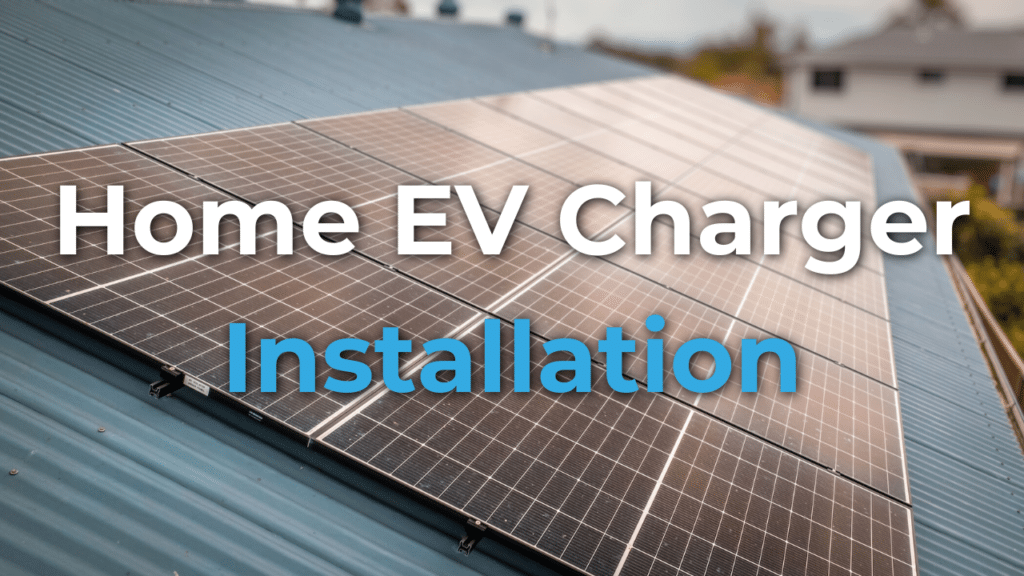
Many new EV owners plug into a regular power outlet overnight, but by morning, the battery is often only half full. This is when folks start looking for “home EV charger installation” and find out there’s a better way.
PSC Energy installs EV chargers for homeowners across NSW, often alongside solar and battery systems. We have experience with all types of homes, including tight switchboards, long garage cable runs, and detached studios.
In this article, you’ll learn about the following:
- Can You Just Use a Regular Power Point?
- Level 1 vs. Level 2 Charging: What the Terms Actually Mean
- What’s Involved in an EV Charger Installation
- How Much Does EV Charger Installation Cost in NSW?
- Smart Charger vs. Dumb Charger: What Do You Need?
- Charging Your EV on Solar
- What to Look for When Choosing a Home EV Charger
- FAQ: EV Charger Installation in NSW
By the end of this guide, you’ll know which charger fits your needs, what an EV charger installation costs in NSW, and how to set up your system for the future.
Can You Just Use a Regular Power Point?
Yes, but it’s not a great long-term solution.
A standard 10A power point gives you about 2.3 kW of power, adding around 9 to 10 kilometres of range per hour. If you drive 30 km a day, you’ll need about 3 hours to recharge. After a long trip, charging can take all night and still not fully top up your battery.
Here’s how the charging options compare:
- Standard 10A power point: roughly 9 to 10 km of range per hour.
- 15A power point: roughly 13 km of range per hour.
- 32A socket: roughly 37 km of range per hour.
- Hard-wired Level 2 charger: roughly 50 to 125 km of range per hour, depending on your car.
A standard power outlet works as a backup or if you only take short daily trips and have lots of time to charge overnight. For most EV owners, having a home charger installed makes things much easier.
Level 1 vs. Level 2 Charging: What the Terms Actually Mean
These terms come up often. Here’s what they mean in simple terms.
Level 1 charging uses a regular household socket. You don’t need any special installation—just plug in. The downside is that it’s slow, so most EV owners switch to other options fairly quickly.
Level 2 charging uses a dedicated circuit installed by a licensed electrician. This is what most people mean when they talk about home EV charger installation. It’s much faster and makes daily EV ownership much more convenient.
Key numbers to know:
- Level 1 delivers 2 to 3 kW and takes 8 to 10 hours to recover 100 km of range.
- Level 2 delivers 7 to 22 kW and recovers the same 100 km in roughly 1 to 2 hours.
- DC fast chargers (public stations, not home units) deliver 50 to 350 kW and add 100 km in under 10 minutes.
For everyday home use, Level 2 is the best option. Just plug in when you get home and wake up to a full battery with no extra planning required.
If you’re interested in learning a bit more about public charging stations, you might want to check out the following article titled, Electric Vehicle (EV) Charging Guide 2026.
What’s Involved in an EV Charger Installation
A licensed electrician must install your home EV charger. In NSW, homeowners can’t do this work themselves. Here’s what you can expect on installation day:
- Switchboard check: The electrician confirms your board has a spare circuit and enough capacity for a dedicated EV charging load. If not, an upgrade may be required before anything else happens.
- Circuit installation: A new dedicated circuit runs from the switchboard to your parking spot. This is where cable length matters. The further the car is from the board, the more work and cost are involved.
- Charger mounting: The unit mounts to a wall near where you park. Most installations use weatherproof enclosures, particularly for outdoor or garage locations.
- Connection and testing: The electrician connects the circuit, tests it, and verifies that the charger communicates correctly. This step matters most for smart chargers, which need proper network and configuration setup to work as intended.
Most straightforward installations take half a day to a full day. Jobs with long cable runs, switchboard upgrades, or three-phase work can take longer. Ask your electrician ahead of time how long they expect the job to take so you can plan accordingly.
Here’s a practical tip: If you’re installing a smart charger, check that your internet connection reaches where the charger will be. Some smart chargers need a steady network for solar integration and scheduling.
How Much Does EV Charger Installation Cost in NSW?
The cost to install an EV charger in NSW depends on your home setup. Here’s what can affect the price.
Hardware:
- Entry-level Level 2 chargers start in the low hundreds of dollars.
- Quality smart chargers with solar integration and OCPP sit in the $1,000 to $2,000 range.
- Premium chargers with advanced features cost more.
Installation:
- Simple install close to the switchboard: $300 to $500.
- Typical suburban home: $1,000 to $1,500.
- Long cable runs, switchboard upgrades, or three-phase work: add $1,200 to $2,000 or more on top.
What pushes EV charger installation cost up:
- Distance from the switchboard to your parking spot (cable costs $10 to $15 per metre).
- Switchboard upgrade, required when there’s no spare capacity or the board is outdated.
- Upgrading from single-phase to three-phase supply, which requires work from your electricity distributor.
- Running cable through finished walls, ceilings, or outdoors with weatherproof conduit.
Here’s a helpful tip: Ask your electrician to install a spare conduit during the job, even if you don’t need it right now. If you add solar, get a second EV, or upgrade your charger later, this will make future work much cheaper.
If you’re interested in learning more about EV chargers, you might want to check out this guide titled, The 10 Best Home EV Chargers in Australia.
Smart Charger vs. Dumb Charger: What Do You Need?
A basic charger does one thing: it starts charging when you plug in and stops when the battery is full. That’s all it does.
A smart charger does considerably more:
- It starts and stops charging based on your solar production.
- It schedules charging during off-peak electricity tariff windows.
- It communicates with your home energy system and other high-draw appliances.
- It supports load management, preventing your switchboard from being overloaded when multiple appliances run simultaneously.
Wondering if you need one? Here’s how to decide:
- You have solar panels: Yes. A smart charger directs excess solar energy to your car rather than exporting it to the grid for a few cents per kWh. Charging becomes nearly free on sunny days.
- You’re on a time-of-use electricity tariff: Probably yes. Smart scheduling means you automatically charge during cheap overnight windows.
- You have a flat electricity rate and no solar: It’s optional. You’ll pay the same rate regardless of when you charge.
OCPP (Open Charge Point Protocol) is the feature worth understanding before you buy. It’s an open communication standard that lets your charger talk to third-party apps, solar systems, and energy management platforms.
A charger with OCPP built in can gain new smart features via software updates over time, even if you don’t need them right now. A charger without it is permanently limited to whatever it shipped with.
Charging Your EV on Solar
This is where paying attention really matters, and where PSC Energy’s experience with both solar and EV systems can make a difference.
Charging your EV with extra solar power is the cheapest way to run a car in Australia. Each unit of solar electricity you send to the grid earns a feed-in tariff, usually 2 to 10 cents per kWh. Buying electricity from the grid costs 25 to 35 cents per kWh.
A smart solar charger sends that extra solar power straight to your car before it goes to the grid, making the cost of charging almost zero.
What you need for solar EV charging to work well:
- A solar system with a meaningful surplus, ideally 10 kW or above.
- A smart charger that can read your solar output via a CT sensor, smart meter, or same-brand inverter integration.
- Single-phase smart charging needs a minimum solar surplus of around 1.4 kW to kick in; three-phase smart charging needs around 4.2 kW.
Three ways to connect your solar to your EV charger:
- CT sensor: A clamp fits around your home’s main cable and tells the charger when surplus solar is available
- Same-brand ecosystem: If your inverter and charger are from the same manufacturer, they communicate directly without extra hardware. This is the most seamless setup.
- Third-party app: Chargers with OCPP can connect to energy management apps that work across almost any inverter brand
What you can realistically save:
If you drive 12,000 km per year and your car covers around 6 km per kWh, you need about 2,000 kWh annually to power it.
At the difference between buying grid electricity and exporting solar, a well-configured solar charging setup can save $300 to $500 per year on fuel alone, potentially more.
If you’re interested in learning a bit more about charging EVs, you might want to check out the following article titled, How Much Solar (and Battery) Do You Need to Charge an EV in Australia?
What to Look for When Choosing a Home EV Charger
Use this checklist when comparing options for your EV home charger installation:
- OCPP compatibility: This is the most important feature. Without it, you’re limited to the manufacturer’s app and can’t connect with third-party solar or energy management systems.
- Single-phase vs. three-phase: Many NSW homes have single-phase power, which limits AC charging to around 7.4 kW. Three-phase homes can access up to 22 kW. Check your supply before buying.
- Tethered vs. untethered cable: A tethered charger has a cable that’s always attached. An untethered charger means you plug in a cable each time, which is handy for homes with more than one EV or different plug types. Both use the Type 2 connector, which is standard in Australia.
- Cable length: 5 metres suits most setups. If your parking situation is awkward, opt for 7 to 8 metres.
- Warranty: Most home EV chargers come with a 2 to 3-year warranty, while a few offer 4 to 5 years. Since the technology is still developing, it’s worth considering warranty length when you choose.
- Load management: Useful if you’re concerned about overloading your switchboard. The charger automatically reduces its draw when other high-demand appliances kick in.
Wrapping Up: Plug Into Savings
Installing a home EV charger is one of the most practical upgrades for any EV owner. The right setup saves you time, keeps your car ready when you need it, and if you have solar, can cut your fuel costs to nearly zero.
PSC Energy installs EV chargers across NSW as part of complete solar, battery, and EV solutions. If you’re looking for an experienced installer or want advice on how a charger would work with your current solar system, contact the PSC Energy team for a free assessment. It’s what we do.
If you’re interested in learning a bit more about charging your EV from solar, you might want to check out the following article titled, Considerations for Charging Your Electric Vehicles with Solar.
FAQ: EV Charger Installation in NSW
How long does a home EV charger installation take?
Most straightforward installs take half a day. If your job involves switchboard work, long cable runs, or three-phase upgrades, allow a full day.
Do I need a licensed electrician for an EV charger install?
Yes. In NSW, all electrical work must be done by a licensed electrician. No matter where you search for EV charger installation near me, always check that your installer has a valid NSW electrical licence before work starts.
Can any electrician do an EV charger install in Sydney?
Technically, yes, if they have a valid licence. But it’s best to choose someone with experience installing EV chargers. An installer who understands charger firmware, load requirements, and solar integration will help you get the most from your setup, not just handle the wiring.
How long does it take to fully charge an EV at home?
It depends on your car and charger. With a Level 2 hard-wired setup, most EVs charge from 20% to 80% in 2 to 4 hours. A full charge from empty takes 4 to 8 hours for most models. Most EV owners simply plug in each evening and wake up to a full battery.
Will I need a switchboard upgrade for my EV home charger installation?
Not always, but it’s common. Your switchboard needs a spare circuit and enough capacity to sustain a high-draw load for hours at a time. If your board is old or already at capacity, your electrician will likely recommend an upgrade.
What is OCPP, and why does it matter for EV charger installation?
OCPP stands for Open Charge Point Protocol. It’s an open standard that lets your charger communicate with third-party software, solar systems, and energy management apps. A charger with OCPP can be upgraded and expanded via software over time. One without it is limited to whatever it shipped with.