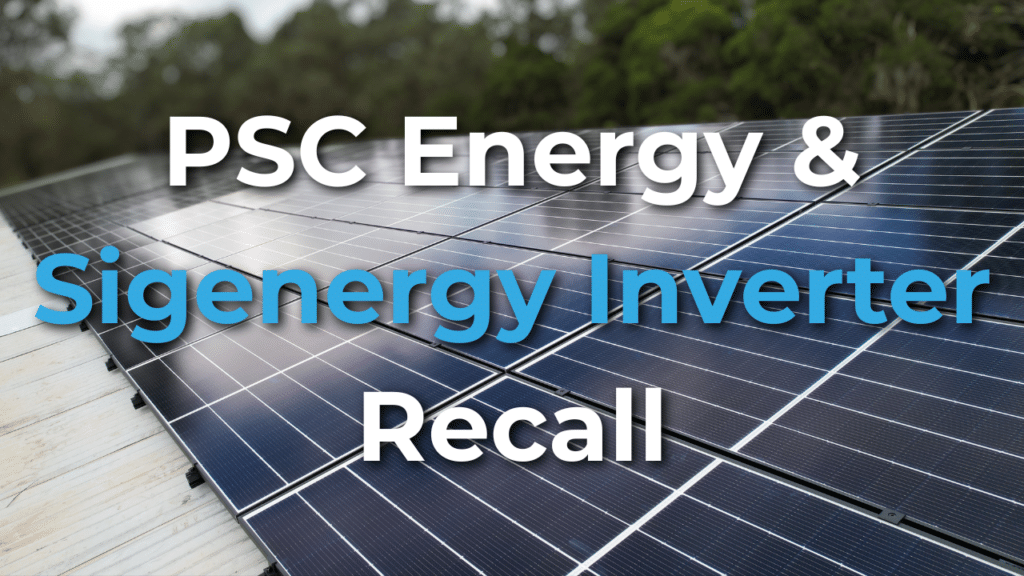
When a recall happens, you want to know your installer can handle replacements quickly. PSC Energy has already replaced inverters in the field. Did your installer give you the same peace of mind?
PSC Energy set up a straightforward replacement program for customers affected by the Sigenergy single-phase inverter recall. We formed a dedicated team, kept the process simple, and acted quickly.
In this article, we’ll explain our process step by step and share what customers experienced.
Key takeaways:
- This program covered Sigenergy single-phase 8 kW, 10 kW, and 12 kW inverters (Energy Controllers) for PSC Energy customers.
- PSC Energy replaced about 480 affected units by 19 February 2026. We planned for a three-month turnaround from the recall announcement to the last replacement.
- We used two-person crews and scheduled weekend runs by area. This helped us work quickly while keeping our quality standards high.
- We replaced the entire inverter unit for affected PSC customers. This gave you a complete fix and a clean result.
PSC Energy tracked each unit from your wall through the warehouse returns process. We kept our communication with customers simple and direct.
The Scope of the Recall
This replacement program included Sigenergy single-phase Energy Controllers in the 8 kW, 10 kW, and 12 kW range. PSC Energy had installed about 480 of these units during the affected period, so we knew we needed a clear plan to handle them quickly and efficiently.
The Goal of PSC Energy
Our goal was to resolve every recall quickly and reliably, making sure each system was fully restored and customer trust stayed strong.
The reasons for this were simple.
- You wanted a clear solution, not ongoing uncertainty.
- You wanted confidence in the system sitting on your wall, clear paperwork, and a process that respected your home and your time.
You were already using the system and checking the app alerts. The last thing you needed was long downtime or an unexpected power bill while waiting for us to act.
As a full-service installer, we take responsibility for everything that happens on-site. We manage our crews, our scheduling, and the results at your home. We don’t hand that off to anyone else.
If you’re interested in learning a bit more about the importance of a good installer for your solar (the most important component of any system, seriously), you might want to check out the following article titled, In-house Installers vs. Subcontractors: Which is Better?
Jake Warner on What the Recall Actually Tested
“It’s not all doom and gloom.
“As director of PSC Energy, going through a recall process like this, there’s a real sense of accomplishment when you handle it well.
“It asks some uncomfortable questions of your business:
- Are your systems good enough?
- Is your service department strong enough to absorb something like this?
- And did you make the right call trusting this manufacturer in the first place?
“We’re only ten years old, and this was just our second product recall. If you’ve followed PSC or read this far, you probably already know we’re strict about what we sell. We don’t put poor-quality products on people’s walls.
“So, when a recall landed on nearly 500 of our sites, we took it seriously. We knew it was going to test our patience, our systems, our relationship with Sigenergy, and the trust we’d built with our clients over the years.”
How Sigenergy Responded to the Recall
Sigenergy’s remedy for affected owners was a full replacement product with updated connection hardware.
The recall centred on the AC plug connection point, and rather than patch it, Sigenergy chose to remove any doubt entirely with new hardware and a clean outcome.
They also added two years of extra warranty coverage on top of the standard ten-year warranty. That matters. A recall can shake your confidence in a product even after it’s been fixed.
That extra coverage gives you more protection in case any issues come up later.
If you’re interested in learning a bit more about working with a solar installer, you might want to check out the following article titled, Top Questions to Ask Your Solar Installer Before Hiring Them.
How PSC Energy Installed the Replacement Inverters
We weren’t trying to profit from this. Our goal was to get it done. We stand behind every system we install, and handling recalls is part of that responsibility.
We used two-person crews for all recall work. This made lifting and mounting safer and helped keep our quality consistent.
Each crew usually completed about six replacements a day when travel and access were easy. We planned jobs by area to reduce travel time and keep quality high, and we often worked Saturdays to get the job done.
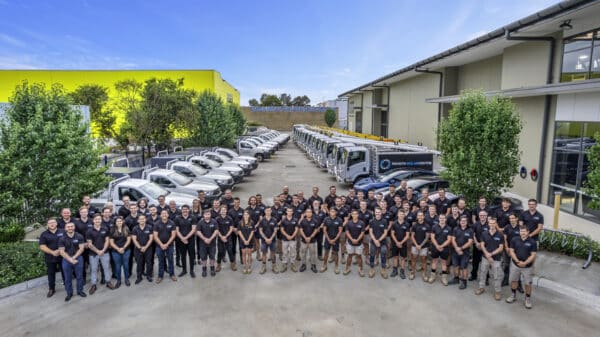
This recall needed a lot of help. The director, installation managers, technical sales managers, and anyone with an electrical licence who could spare a Saturday joined in.
We created a dedicated task force to handle planning, stock flow, customer contact, and daily problem-solving. The team met often, worked quickly, and put in extra hours on weekends without affecting our regular installation schedule.
Jake Warner on the Three-Month Turnaround
“When we had our day of no single-phase inverters going out on 19 November 2025, I said to my team: ‘If we get this all done by 19 February 2026, that’s a three-month turnaround, which is almost unheard of.’
“My team probably wasn’t too sure it was possible at that stage. And I’ve got to be really honest; I wasn’t too sure either.”
“I believed we could do it, but I didn’t expect Sigenergy to get us the inverters so quickly. To my surprise, they worked around the clock in the first two weeks to make sure they understood how we’d be running the replacements.
“The first inverters didn’t ship until around Christmas, so we wouldn’t get any done until at least the first week of January. That timing actually gave us breathing room; time to talk properly with affected clients and plan the runs carefully, instead of scrambling.”
How We Built the Replacement Calendar and Contacted Customers
The task force divided our service area into different runs, grouping jobs by location and route.
Two-person crews worked every weekend, with about fourteen jobs planned over two days. We scheduled jobs close together and allowed for realistic travel times.
We contacted each customer as soon as we scheduled their area. We sent an email and SMS to confirm the booking, share the arrival window, and let them know about anything that could affect timing, like weather or traffic. Our communication was simple and direct.
If you’d like to learn a bit more about the cost of SigenStor, we recommend you check out the following article titled, How Much Does the Sigenergy SigenStor Cost?
PSC Energy and Replacement Day
Replacement day didn’t ask much of you. The prep steps were essentially the same things we ask on any installation day:
- Keep the inverter area clear.
- Secure any pets.
- Make a park available if the inverter is far from the street.
- Make sure we can get to the meter and switchboard.
- Keep your phone nearby in case we need app access.
- Arrange gate or garage access if the inverter is behind a locked area.
Some sites could be accessed safely without the customer present, while others needed someone at home. We explained this when booking, so there were no surprises on the day.
What a Typical Visit Looked Like
The crew arrived and confirmed site details.
- They shut the system down in a controlled sequence.
- Removed the old inverter.
- Installed the new one with updated connection hardware.
- Tested the system. Confirmed safe operation.
- Checked the monitoring and app where possible.
- Completed the paperwork.
- And sent a completion email.
Done.
Power usually only flickered for a moment during commissioning. The swap itself took about 45 minutes, and most replacements were finished within two hours.
Some sites took longer because of access, cable runs, or switchboard layout. These factors could add time, but we still planned for a normal service window.
If you’d like to learn a bit more about Sigenergy’s SigenStor, you might want to check out the following article titled, Pros and Cons of the Sigenergy SigenStor Solar Battery and Energy System.
Why We Replaced the Inverter, Not Just the Terminal
The recall focused on the AC connection point, so why not just swap the terminal hardware on site?
The honest answer is that on-site terminal replacement isn’t a quick job. It meant removing the front cover and internal components from the Energy Controller to fit the new terminal.
That work happens in real-world conditions, not a controlled workshop. Dust, heat, moisture, and tight spaces introduce variables that a factory environment doesn’t have.
Sigenergy chose the cleaner path: remove the unit and replace it with a refurbished unit that had been through their internal processes to confirm safe operation.
We agreed with this decision. It meant every customer got the same consistent result.
What We Saw While Replacing Inverters
Jake noticed something that stayed with him, and it wasn’t about paperwork.
“We never encountered anyone who was disappointed with their purchase. People were impressed by how quickly we moved. They were impressed that Sigenergy, a relatively young manufacturer, owned the problem and honoured the warranty. And they were impressed that our team rocked up on a Saturday, at all hours, with smiles on their faces.
“As director, what impressed me most was the standard of work my team left behind. It was genuinely rare to find so much as a stray cable on the ground. Sites were clean. Silicon work was neat. Compliant bollards fitted in garages where needed. At the end of every job, the team wiped down the inverter and batteries as though they’d just come off the factory line, then made sure the client understood their system before leaving.”
There was another unexpected benefit to all these face-to-face visits: real conversations. Some customers asked about adding an EV charger or increasing their battery capacity.
Those conversations weren’t the main reason for the recall, but they reminded us that showing up and doing the job right builds trust that lasts beyond the work itself.
If you’d like to learn a bit more about SigenStor, a solar battery we carry, we recommend you check out the following article titled, Sigenergy SigenStor Review.
What Sigenergy Did Right
- Sigenergy reworked stock before it left the warehouse.
- Updated connection hardware became the new standard for all replacement work.
- They built post-sales support into the app to help owners and installers move through the process with less confusion.
- And they added the two-year warranty extension for every affected customer.
Large recalls put a lot of pressure on support systems, response times, and logistics. Sigenergy’s quick response and strong support made our job much easier.
Wrapping Up: Recalled, Replaced, Relieved
Recall stories spread quickly and often cause worry. But you didn’t need to worry about this one. You needed a clear process and a good result, and that’s what PSC Energy and Sigenergy delivered.
We made the plan, staffed the work, ran the area-based replacement runs, and finished with clean installations and clear paperwork. Three months after the announcement, we were done.
We’re very proud of our team and truly impressed by how Sigenergy handled their part.
If you’re interested in learning a bit more about solar and battery rebates in NSW, Australia, you might want to check out the following article titled, Ultimate Guide to Australia’s 2026 Solar Rebate and Battery Rebate: Federal and NSW Rebate for Solar.