Updated on November 19, 2025
If you’re investing in a solar system, you’re probably wondering about how long it will last. The warranty periods for solar components are all different. When will you need to replace an inverter?
At PSC Energy, we’re committed to getting Australia to Net Zero by 2050, and in that spirit, we’re here to teach you everything related to solar systems. A knowledgeable customer eventually becomes a happy customer who is changing the world through renewable energy (and saving money too).
In this article, you will learn:
- How Long Do Solar Panels Last?
- What is the Lifespan of a String Inverter?
- What is the Lifespan of a Microinverter?
- What is the Lifespan of a Powerwall 3?
- Weather and Environmental Impact
- Maintenance: Extending the Lifespan of Solar Systems
- FAQ: Inverter Lifespan
By the end of this article, you’ll have a general understanding of how the warranty periods of microinverters, string inverters, and Powerwall 3 affect the cost of your system. Onwards!
How Long Do Solar Panels Last?
- Solar panels are the crown of every solar system. Most solar panels are warranted 25 years for product and 30 years for performance.
- However, solar panels don’t operate at peak performance forever. Over time, they degrade, losing efficiency. On average, a high-quality solar panel will degrade by about 0.5% to 1% each year. This means that after 30 years, a panel operating at 85-90% efficiency is typical.
- Weather and sunlight exposure are major factors affecting how quickly a panel degrades. Panels in extremely hot or very cold climates may wear out faster as the physical materials expand and contract against the elements.
- Debris and dirt build-up can also reduce panel efficiency, which is why regular cleaning is essential. To maintain performance, it’s recommended to clean your panels annually, especially in areas with high dust or pollution.
If you’re interested in learning a bit more about solar panels and energy systems, you might want to check out the following article titled, Are Solar Panels Worth It in NSW, Australia? A Price Breakdown for 2025.
What is the Lifespan of a String Inverter?
- A string inverter is a component of your solar system. It’s mounted on the side of the house in a central location.
- It converts direct current (DC) electricity from solar panels into alternating current (AC) electricity, which can be used by your home.
- Solar panels are connected in series (a string) to a single inverter. They work like a “string” of Christmas lights. The performance of each panel affects the others. When one panel underperforms, the other panels all drop to match that panel’s output.
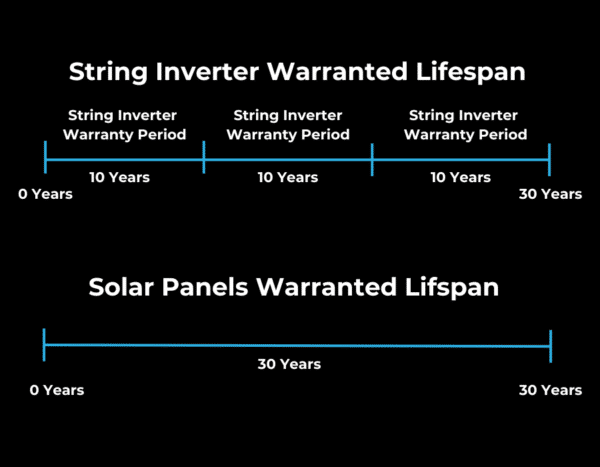
- String inverters are typically warranted for 5 – 10 years. Some solar customers can stretch the lifespan to 15 years, but those are exceptions that prove the rule.
- This means string inverters may need to be replaced twice during the lifespan of the solar panels.
- Whatever the cost of your string inverter should be tripled and included in the price.
If you’re interested in learning a bit more about how microinverters compare to string inverters, you might want to check out the following article titled, Microinverters vs. String Inverters: A Transparent Comparison.
What is the Lifespan of a Microinverter?
- A microinverter is a small device mounted underneath each solar panel in a solar system.
- It converts the DC power to AC power immediately. As soon as it’s harvested, it starts converting that power.
- Unlike string inverters that manage multiple panels at once, each microinverter works independently for each solar panel. This means that if one panel underperforms (due to shading or damage), the others will continue generating electricity at their full potential.
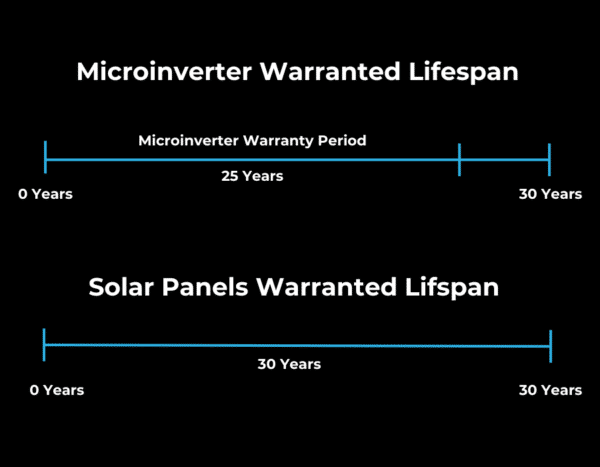
- Microinverters are warranted for 25 years.
- This means that microinverters potentially need to be replaced once during the lifespan of the solar panels. Honestly, though, Enphase claims that they’ll last much longer than 30 years. So they probably won’t need replacing before your solar panels wear out.
If you’re interested in learning a bit more about microinverters, you might want to check out the following article titled, Myths & Misconceptions About Solar Microinverters.
Click here for solar solutions.
What is the Lifespan of a Powerwall 3?
- The Tesla Powerwall 3 is a new solar system disguised as a battery. It’s a battery/hybrid inverter combination that can be installed as an AC or DC-coupled battery and system.
- The Powerwall 3 supports up to 20kW of solar, which is a lot of panels. The solar input actually bypasses the hybrid inverter when it’s charging from the solar on the roof creating greater charging efficiencies. The hybrid inverter changes the DC power in the battery to AC power for the home to use.
- When panels experience things like shading or different orientations, Powerwall 3 adjusts and optimises the power output to achieve the best possible performance across three strings of solar panel arrays. When one array drops in efficiency due to shading or some other obstruction, the other two won’t be affected.
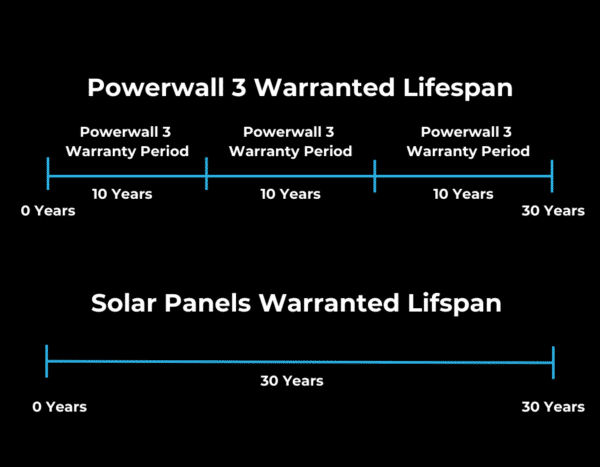
- Powerwall 3 is warranted for 10 years. Because the inverter is enclosed with the battery, the whole system is warranted, not the individual components.
- This means that Powerwall 3 will need to be replaced twice over the lifespan of solar panels. The price of the Powerwall 3 unit alone should be tripled when calculating the cost of battery + hybrid inverter.
Please Note: Because the Powerwall 3 is a battery as well as an inverter, the value is different from an inverter alone. It’s two components in one, but the battery will work with your system to offer far more energy independence than solar panels working alone. So while it will need to be replaced, the value is different from the other systems. Please keep this in mind.
If you’d like to learn more about Tesla products, we recommend you check out the following article titled, Tesla Powerwall 3 Review: An In-Depth Look at Tesla’s New Solar Battery.
Long-Term Value: Lifespan vs. Cost
While microinverters have higher upfront costs than string inverters, their longer lifespan (up to 25 years) and lower maintenance requirements provide great long-term value. You’re less likely to face system downtime or costly replacements, which means greater savings over the lifespan of your system.
String inverters, with their shorter lifespan, offer a lower initial price but may cost more in the long run due to the need for replacement every 5 to 10 years. The upfront savings may be appealing, but it’s important to factor in the additional costs of replacement and potential downtime.
The Tesla Powerwall 3 balances its higher price with the ability to store energy and provide backup power, which is particularly valuable in areas with frequent power outages or high energy costs. It’s a strong option for homeowners looking for energy independence and long-term savings. But it will need to be replaced and the cost of that can’t be ignored.
If you’d like to learn more about the price of a Powerwall 3, you might want to check out the following article titled, How Much Does a Tesla Powerwall 3 Cost?
Weather and Environmental Impact
The environment where your solar system is installed plays a significant role in the lifespan of its components. Extreme temperatures, strong winds, hailstorms, and snow can all impact solar panels, inverters, and batteries.
Solar panels are built to endure different climates, but continuous exposure to extreme heat or cold can speed up degradation. For instance, panels in extremely hot climates may degrade faster due to how heat affects the components.
Over time, this reduces their ability to convert sunlight into electricity efficiently. It’s a temperature coefficient, and every solar panel has one. Each degree the temperature increases, efficiency decreases by a fraction of a percent.
Similarly, wind damage can harm mounting systems, causing panels to shift out of place. In coastal areas, salt corrosion can also affect the performance of panels and inverters. Choosing high-quality materials can help prevent this issue.
Weather conditions can also impact inverters. String inverters, often installed outdoors, are more exposed to the elements, which can reduce their lifespan. Microinverters, mounted beneath each solar panel, are generally more protected from direct exposure, which helps them last longer.
If you’re interested in learning a bit more about how weather affects your solar panels, you might want to check out the following article titled, How Does The Weather Affect Your Solar Panels?
Maintenance: Extending the Lifespan of Solar Systems
Regular maintenance is key to ensuring your solar system operates at peak performance for as long as possible. Cleaning the panels to remove dust, debris, and bird droppings can help maintain their efficiency. It’s recommended to clean your panels at least once a year, or more frequently if you live in a dusty area.
Monitoring software, like the Tesla app for Powerwall systems, can help you track energy production and detect early signs of performance issues. Identifying and addressing problems early can prevent more serious failures and costly repairs down the road.
Ensuring that your system is properly installed and maintained by qualified technicians can also reduce wear and tear on components. Professional inspections every few years can help spot potential issues, such as loose wiring or corrosion, that may otherwise go unnoticed.
If you’re interested in learning a bit more about the importance of a good installer for your solar (the most important component of any system, seriously), you might want to check out the following article titled, In-house Installers vs. Subcontractors: Which is Better?
Click here for sunshine and savings.
What Did the Wind Turbine Say to the Solar Panels About Renewable Energy? I’m a Big Fan.
- Replacing components adds up over the lifetime of your solar panels.
- Maintenance costs can vary, but regular upkeep can help extend the life of inverters.
- Consider both upfront costs and long-term expenses when choosing your solar system.
At PSC Energy, we install Enphase microinverter systems, string inverter systems, and Powerwall 3 systems. All three offer exceptional value for customers depending on your unique energy needs and goals. We’re here to help you through that selection process. It’s what we do.
If you’re interested in learning a bit more about solar and battery rebates in NSW, Australia, you might want to check out the following article titled, Ultimate Guide to Australia’s 2025 Solar Rebate and Battery Rebate: Federal and NSW Rebate for Solar.
FAQ: Inverter Lifespan
What does an inverter do in a solar system?
An inverter turns the DC electricity from your solar panels into AC electricity that your home can use.
Every grid-connected solar system needs an inverter. Without it, your panels will sit on the roof and create power that your home cannot use.
There are three main inverter setups in this comparison.
- A string inverter
- Microinverters under each panel
- A Tesla Powerwall 3, which includes a hybrid inverter and a battery
Each option handles power in a different way. Each option also has a different lifespan and cost over time.
How long do solar panels usually last?
Most quality solar panels last 25 to 30 years.
Panel makers often give two types of warranties:
- A product warranty for about 25 years
- A performance warranty for about 30 years
Panels slowly lose efficiency each year. A good panel often loses around 0.5 to 1 percent of output each year. After 30 years, many panels still work at about 85 to 90 percent of their original power.
Heat, cold, and harsh weather can speed up this wear. Dust and dirt also reduce output if you never clean the panels. If you clean them regularly and install them well, you give them the best chance to reach that full 25 to 30 year life.
How long does a string inverter last?
A string inverter usually lasts much less time than your panels.
Most string inverter brands give a warranty of about 5 to 10 years. Some units keep working for up to 15 years if you care for them and if they run in a mild climate. That longer life is the exception, not the rule.
In a standard 25 to 30 year panel life, you should plan to replace a string inverter at least twice. You buy one with the system. You then replace it once around year 8 to 10. You may replace it again around year 18 to 20.
When you plan your budget, you should treat the inverter price as a repeated cost. Many people take the cost of the original string inverter and multiply it by three. That rough number covers the unit you buy today and the likely two replacements in the future.
Why do string inverters often cost more in the long run?
String inverters look cheaper at the start. The unit price is lower than microinverters or a Powerwall 3. The long term picture tells a different story.
You need to consider:
- The shorter 5 to 10 year warranty
- The need for at least two replacements in a 25 to 30 year panel life
- The labour cost every time you swap the inverter
- The possible downtime while you wait for parts or repairs
When you spread those extra costs over the life of the system, the “cheap” string inverter can become quite expensive. It might still suit some budgets. You just need to include those future replacement costs in your plan.
How long do microinverters last?
Microinverters sit under each panel and work panel by panel.
Most premium microinverter brands, such as Enphase, offer a 25 year warranty. That matches the product warranty on many modern solar panels.
Because microinverters run cooler and handle smaller amounts of power per unit, they often last longer than a single hard-working string inverter. Enphase even claims that their microinverters can keep going well past 30 years in normal conditions.
In most cases, you will not replace microinverters more than once during the life of your panels. In many systems, you may not replace them at all before you replace the panels.
How do microinverters change long term solar costs?
Microinverters cost more upfront. You buy one microinverter per panel instead of one string inverter for the whole array.
You gain a few long term benefits:
- A 25 year warranty instead of 5 to 10 years
- Less chance of a full system outage from a single failure
- Panel level performance, so one shaded panel does not drag down the whole string
- Fewer planned replacements over the life of the system
You can often avoid one or two major replacement events that you would face with a string inverter. That reduces long term costs. It also protects you from future price rises on parts and labour.
What is Tesla Powerwall 3 and how does it act as an inverter?
Tesla Powerwall 3 is more than a battery. It is a battery plus a hybrid inverter in one unit.
It can work in an AC-coupled setup or a DC-coupled setup. That means it can pair with an existing system or form the heart of a new one.
Key points about Powerwall 3:
- It can accept up to 20 kW of solar input, which supports a large rooftop system
- When it charges from solar, the DC power from the roof can bypass part of the hybrid inverter on the way into the battery to improve charging efficiency
- The hybrid inverter then turns the DC power stored in the battery into AC power for your home
- It can manage three separate panel strings and optimise power across them
When one array on the roof suffers from shade or a different direction, Powerwall 3 can adjust and keep the other two strings running at a higher output. That control gives better overall performance than a basic central inverter with no optimisation.
How long does a Tesla Powerwall 3 last?
Tesla gives Powerwall 3 a 10 year warranty. That warranty covers the battery pack and the built-in inverter together.
Why is the value of a Powerwall 3 different from a stand-alone inverter?
A Powerwall 3 costs more than a basic string inverter or a set of microinverters. It also does more.
Powerwall 3 gives you:
- A large home battery
- A built-in hybrid inverter
- Backup power when the grid fails
- Better control over when you use solar, stored power, and grid power
You still need to plan for replacements every 10 years or so. You also need to weigh that against the benefits of:
- Lower bills from shifting usage away from high tariffs
- Backup during blackouts
- Higher self-consumption of your own solar
- A higher sense of energy independence
So the value is not only about lifespan. It is about what that battery plus inverter combo does for your home each day.
How does weather and climate affect panels, inverters, and batteries?
Weather affects every part of your solar system.
Panels face sun, wind, rain, dust, and heat all year. Heat reduces panel efficiency. Every degree of extra temperature cuts power by a small fraction. Over many summers, this wear speeds up panel degradation.
Other common weather and environmental risks include:
- Strong wind, which can stress mounting and fixings
- Hail, which can damage glass and frames in severe storms
- Salt in coastal areas, which can corrode metal parts and damage inverters
- Dust and pollution, which can sit on panels and block light
String inverters often sit on an outside wall and take more direct exposure. Harsh sun and wide temperature swings can shorten their life. Microinverters sit under the panels on the roof, so the panels shield them from some direct weather. That extra protection helps them last longer.
Powerwall 3 usually sits on a wall in a more sheltered location. Good installers choose a spot with shade and airflow. That placement helps protect the battery and electronics from extreme heat and direct rain.
How does inverter lifespan affect the real price of a solar system?
The sticker price of a system is only the start. Inverter lifespan plays a big role in the real cost over 25 to 30 years.
Look at each choice in simple terms:
- String inverter: low initial cost, short life, and likely two replacements
- Microinverters: higher initial cost, long life, and fewer or no replacements
- Powerwall 3: highest cost, 10 year life, and two replacements over panel life, but includes a battery and hybrid inverter
If you ignore replacement costs, string inverters look cheap. If you include replacements, labour, downtime, and risk of failure at a bad time, the picture shifts.
Microinverters may cost more on day one, but they can save money and stress over time. Powerwall 3 sits in its own category. It costs more but offers storage and backup that no inverter-only system can match.
How do I choose between string inverters, microinverters, and Powerwall 3?
You choose the best option by looking at your roof, your budget, and your goals.
A string inverter can suit you if:
- You want the lowest upfront cost
- Your roof has one or two simple faces
- You accept that you will replace the inverter at least twice
Microinverters can suit you if:
- You want a long life that matches your panels
- Your roof has complex angles, partial shade, or multiple directions
- You want strong monitoring and the lowest risk of full system loss
Powerwall 3 can suit you if:
- You want backup power during blackouts
- You want to store solar and use it later at night
- You accept that you will replace the unit about every 10 years
- You value energy independence as well as bill savings
You can also combine options. For example, you can pair microinverters on the roof with a battery later. A good installer can walk you through each path using your home and your numbers.