Updated on May 13, 2026
You’ve decided to go solar. You’ve compared panels, looked at quotes, and you’re ready to take the next step. Then a sales rep says they use subcontractors for installation, and you wonder if that’s an issue.
It’s a solid concern. Who installs your solar system affects the quality of the work, who’s responsible if something goes wrong, and what you pay upfront.
At PSC Energy, we do everything in-house. From your initial query to fulfilling your product warranties, we’re here every step of the how. So we’re a bit biased on this topic. However, we’re here as educators first today.
In this article, you’ll learn about the following:
- What’s the Difference Between an In-house Solar Installer and a Subcontractor?
- In-house Solar Installers: Pros and Cons
- Solar Subcontractors: Pros and Cons
- What Happens to Your Solar Warranty If Something Goes Wrong?
- A Quick Word on PSC Energy
- How to Choose the Right Solar Installer for Your Home
- FAQ: Solar Installers
By the end of this article, you’ll have a clear look at both in-house installers and subcontractors so you can choose what’s best for your home.
What’s the Difference Between an In-house Solar Installer and a Subcontractor?
In-house solar installers handle every part of the job themselves. Their electricians are full-time employees, trained on the company’s products, and responsible for your system from start to finish. They are certified by Solar Accreditation Australia (SAA).
Solar subcontractors, sometimes called “subbies,” are independent electricians who also have SAA certification. The solar sales company hires them for each job to do the installation. They are not full-time employees of the sales company.
In short, an in-house team handles everything themselves. With a subcontractor, the company that sold you the system passes the installation to another business.
If you’d like to learn more about that, we suggest you check out the following article titled, How Long Will My Solar Install Take?
In-house Solar Installers: Pros and Cons
Pros:
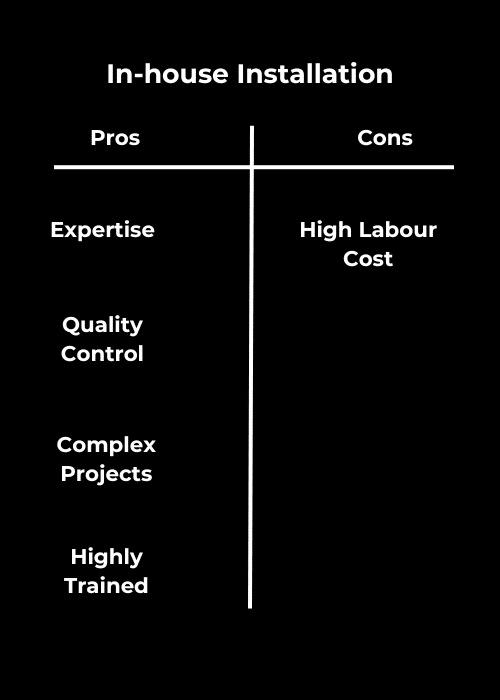
- Deep product knowledge. In-house teams work with a small range of products and install them daily. This regular practice builds strong expertise. For example, an installer who only works with microinverter systems will know every detail of that process.
- Clear accountability. When both the installation and sales teams work for the same company, you always know who to contact if there’s a problem. They won’t send you elsewhere.
- Better for complex jobs. Unusual roof shapes, large systems, or technical setups like microinverters need special training. In-house teams are trained for these situations.
- Ongoing training. In-house teams keep up with new solar technology because it’s their main focus. At PSC Energy, apprentices complete hands-on training at the company’s facility before working on customer roofs.
- One point of contact. If you have a fault or need to make a warranty claim, you deal with the same company for the life of your system.
Cons:
- Less pricing flexibility. Because their labour costs are fixed, in-house teams have less room to offer discounts, no matter when you book or how big your system is.
- Higher upfront cost. Hiring full-time electricians with fixed salaries costs more than paying per job, so you pay more upfront.
- Longer wait times. In-house teams can only take on so many jobs. During busy times, you might wait weeks or even months.
If you’re interested in learning a bit more about our service department at PSC, you might want to check out the following article titled, Penrith Solar Centre’s Service Department Safeguards the Future of Your System.
Solar Subcontractors: Pros and Cons
Pros:
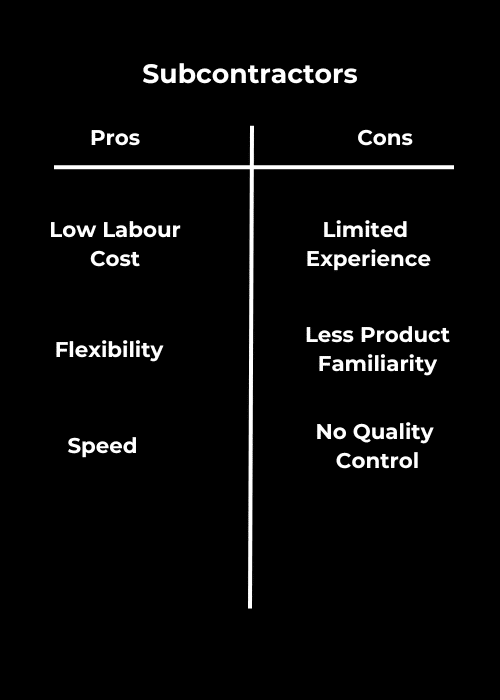
- Lower upfront cost. Subcontractors work job by job, so their rates are often lower. For smaller systems, the savings can be significant.
- Faster availability. With a network of subcontractors, solar companies can be more flexible with scheduling. You might get your installation date much sooner.
- Faster installation. Subcontractors are often paid for each panel they install, so they tend to work quickly. If you want your system up fast, this can be a big plus.
Cons:
- Variable expertise. Subcontractors do many types of electrical work, not just solar. Their experience with certain systems can vary widely. For example, someone who has installed many string inverter systems might not have much experience with microinverters, and they may not mention that unless you ask.
- Limited quality control. Without a direct employment relationship, the sales company has limited oversight over how the job gets done. Some subcontractors do excellent work. Others book two jobs in a day to hit their income targets and rush through both.
- Hard to verify experience. You often have no way of knowing whether the installer has completed 10 solar jobs or 1,000. SAA certification tells you they’re qualified. It doesn’t tell you how much hands-on experience they have with your specific system type.
If you’re interested in learning a bit more about what our team does, you might want to check out the following article titled, What to Expect on the Day of Your Solar Installation.
What Happens to Your Solar Warranty If Something Goes Wrong?
This is the most important question to ask before choosing an installer, but most people don’t think about it until there’s a problem.
With an in-house solar installer, the answer is clear. One company sold the system, and one company installed it. If there’s a fault, you call them, and they fix it.
With a subcontractor model, it can get complicated. Here’s what often happens:
- Your system develops a fault.
- You contact the solar sales company.
- They say it’s an installation issue and refer you to the subcontractor.
- The subcontractor says it’s a product fault and sends you back to the sales company.
- Your system stays offline while you go back and forth, and you end up paying for grid electricity during that time.
This happens. Before you sign with any company that uses subcontractors, get a written answer to this question: Who is responsible for warranty claims and post-installation repairs, and under what conditions?
If you’re interested in learning a bit more about the warranties for the products we install, you might want to check out the following article titled, A Complete Guide to Solar Warranties.
A Quick Word on PSC Energy
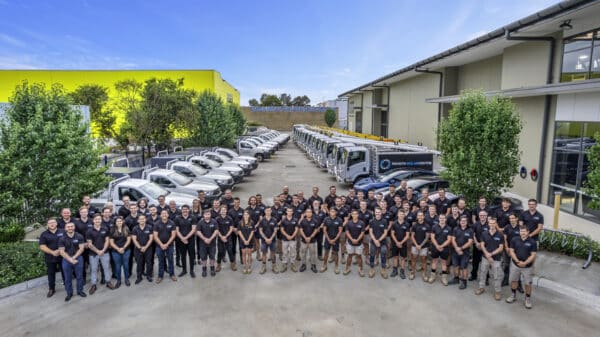
PSC Energy is an in-house solar installation company in the Sydney region. Every installer is a full-time employee. Company founder Jake Warner holds an electrical contractor’s licence, as do the head electricians and members of the service department.
PSC Energy specialises in solar systems and batteries. Because installations are technically complex, the team trains specifically for them.
If something goes wrong with a PSC Energy installation, PSC Energy fixes it.
Still, we’re not the best fit for everyone. If you have a small, simple system and want to keep costs low, a good subcontractor might be a better option. The aim of this article is to help you decide what’s right for you.
How to Choose the Right Solar Installer for Your Home
Ask yourself these four questions before you make a decision:
How big and complex is your system? Large or technical setups, benefit from an in-house team’s special training. Smaller, simple jobs may not need that level of expertise.
What’s your budget? Subcontractors usually cost less upfront. But if you look at long-term performance, fewer service calls, and easier warranty claims, paying more for an in-house team could save you money over time.
How quickly do you need it done? If you’re flexible, waiting isn’t a problem. If you need a fast installation, a subcontractor network gives you more choices.
How much does accountability matter to you? If you want one company to handle everything from sale to service, choose in-house. If you’re comfortable checking references, reading reviews, and confirming experience, a subcontractor can also be a good choice.
There’s no one-size-fits-all answer. The best choice depends on your system, your budget, and how much certainty matters to you.
If you’re interested in learning a bit more about working with a solar installer, you might want to check out the following article titled, Top Questions to Ask Your Solar Installer Before Hiring Them.
FAQ: Solar Installers
What is an in-house solar installer?
An in-house solar installer is a company where the electricians who install your system are full-time employees of that same company. They handle everything from the initial inquiry through to installation and aftercare, without outsourcing any part of the job.
Are solar subcontractors qualified to install solar systems?
Yes. Solar subcontractors must hold Solar Accreditation Australia (SAA) certification to legally install solar in Australia. That certification confirms they meet the minimum legal requirements. It doesn’t tell you how much experience they have with specific system types, so ask that question directly.
Is an in-house solar installation more expensive than using a subcontractor?
Generally, yes. In-house teams employ full-time electricians with fixed salaries, and that cost factor is included in the installation price. Subcontractors work per job, which typically results in lower labour costs. The difference tends to be more noticeable on smaller systems.
What happens to my solar warranty if a subcontractor installs my system?
It depends on the agreement between the solar sales company and the subcontractor. Some companies take full responsibility. Others direct warranty claims related to installation back to the subcontractor. Ask in writing before you sign: who handles warranty claims and repairs, and under what circumstances?
How do I check if a solar installer is reputable?
- Read Google and Product Review ratings, focusing on written reviews rather than just the star score.
- Ask how long they’ve been in business and how many installations they’ve completed.
- Ask specifically how many installs they’ve done with your system type.
- Confirm in writing who handles post-installation repairs and warranty claims.
- Check if they appear on the Clean Energy Council-approved retailer list.
Which type of solar installer is better for a microinverter system?
Microinverter systems are more technically complex to install than string inverter systems. An in-house team with specific microinverter training is generally the safer option. If you want to use a subcontractor for a microinverter install, ask whether they’ve completed training through Enphase University and how many microinverter systems they’ve installed before yours.