You have looked at commercial solar before. You know roughly how the numbers work, you have had a quote or two, and you have talked yourself out of it. The upfront cost was too high. The rebate that made household solar a no-brainer simply did not apply to your building. The red tape around grid connections added another layer of uncertainty. And so the panels never went up.
The scheme that locked you out just changed.
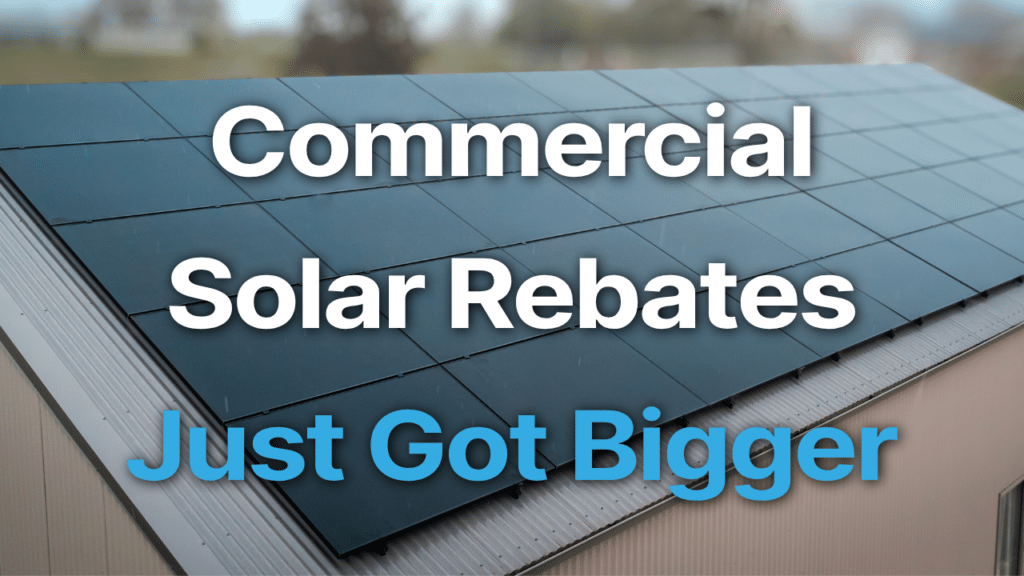
The federal government has announced a major expansion of the Small-scale Renewable Energy Scheme (SRES), the same program behind the solar on one in three Australian homes. From 2026, the scheme will apply to commercial solar systems up to 1 megawatt (1,000kW), up from the previous cap of 100kW. For the first time since the scheme launched in 2011, businesses, farms, schools, warehouses and large commercial buildings can access a commercial solar rebate.
PSC Energy is a CEC-accredited solar installer based in Penrith, Western Sydney. We have been helping businesses install solar for years. We know how the SRES works on the ground, what the approval process actually looks like, and where the gaps still exist. In this article, you will find out exactly how much your business could save, who qualifies, and what the fine print says.
What Is the SRES and Why Didn’t It Work for Businesses Before?
The SRES is a federal government scheme that gives you an upfront discount when you install a qualifying solar system. It works through certificates called Small-scale Technology Certificates (STCs). When you install a system, your installer creates a set number of STCs based on the size of your system and your location. Your installer sells those certificates on the open market and uses the proceeds to reduce your purchase price. The discount comes off at the point of sale. You never see the certificates. You just pay less.
This has worked extremely well for households. It helped push Australia’s residential solar capacity to 22 gigawatts and 4.5 million homes.
The problem for businesses has always been the cap. The SRES has only applied to systems up to 100kW since 2011. That is enough for a house or a small shopfront, but it falls well short of what most commercial buildings need to make a meaningful dent in their energy bills.
- A factory, cold storage facility or large office typically needs a system well above 100kW to cover its daytime consumption.
- Systems above 100kW generated no STCs, meaning businesses paid full price with no equivalent incentive.
- As a result, Australia’s commercial solar capacity sits at just 5.6 gigawatts, less than a quarter of the residential figure, despite businesses using far more electricity overall.
That gap is what the government is now trying to close.
What Is Changing: The Cap Goes from 100kW to 1MW
The new threshold is 1 megawatt (1,000kW). That is a tenfold increase on the previous limit, and it brings the majority of medium-sized commercial buildings into scope for the first time.
Climate Change and Energy Minister Chris Bowen described the gap the current scheme leaves as the “missing middle.” Large commercial buildings sit at the heart of this change: sheds, warehouses, production facilities and industrial rooftops that carry thousands of square metres of untapped solar potential.
Here is what the expansion means in practice:
- Any new solar installation between 100kW and 1,000kW will now generate STCs, giving your business an upfront rebate it was previously excluded from.
- The government estimates the change will cut installation costs by around 20 per cent on average.
- The reform is paired with a separate push to speed up grid connection approvals for commercial systems (more on that below).
The technical potential is significant. Put together, the untapped rooftop potential across business, farming and industrial buildings in Australia exceeds 80 gigawatts of solar capacity. The Smart Energy Council estimates that figure matches the combined output of ten of Australia’s biggest coal plants.
How Much Could Your Business Save? Real Numbers
The government has released savings estimates based on system size. These figures are calculated using the current STC mechanism and give a solid benchmark for what to expect:
- A 250kW system suits a medium retail or commercial building and saves roughly $70,000 off the installation price.
- An 850kW system suits a large logistics centre or retail complex and saves more than $230,000 off the installation price.
- Across eligible system sizes, the average reduction in installation cost is approximately 20 per cent.
A real-world example shows what that 20 per cent figure means in practice: a business owner from a NSW Central West winery, commenting on the ABC’s coverage of this announcement, said a reduction of that size was “probably enough to enable the business case to get loans from the bank.” Businesses that have been sitting on a feasible-but-not-quite-there solar proposal often find that shift in the upfront number is the deciding factor.
The Cheaper Home Batteries Program, launched in 2025, provides a subsidy worth around 30 per cent of the upfront cost of a battery and runs alongside the SRES. Both incentives can apply to their respective components if you are considering adding storage to your commercial system.
How does the solar rebate actually work? Read the full breakdown →
What Businesses Qualify for the Expanded Commercial Solar Rebate?
The expanded SRES applies to new solar installations between 100kW and 1,000kW, installed by a CEC-accredited installer using CEC-approved components. The rebate covers the solar panels and inverters, not the battery. The battery has its own separate program.
The types of buildings most likely to benefit include:
- Factories and manufacturing facilities
- Warehouses and distribution centres
- Farms, sheds and agricultural buildings
- Schools, universities and TAFE campuses
- Hospitals, aged care facilities and medical centres
- Shopping centres and large retail premises
- Offices with significant north-facing roof space
If your building already has a system below 100kW that was installed before this expansion, you cannot go back and claim STCs on the existing portion. However, expanding the system to take advantage of the new threshold may be possible depending on your current setup and grid connection capacity.
Is Your Business a Good Fit for a Commercial Solar Energy System? →
The Grid Connection Problem and the Government’s Fix
Cutting the upfront cost is only part of the solution. One of the biggest hidden barriers to commercial solar has been the grid connection approval process.
Getting approval to connect a medium-sized commercial system to the network has historically been slow and hard to predict. Johanna Bowyer, Lead Analyst for Australian Electricity at the Institute for Energy Economics and Financial Analysis, put it plainly: the process “can be slow and unpredictable, and that can discourage investment.”
Businesses experience this in three ways:
- Extended project timelines that tie up capital and delay the return on investment.
- Unpredictable outcomes that make it hard to plan or get lender approval.
- Additional holding costs while waiting for network sign-off.
The federal government has asked the Australian Energy Market Commission (AEMC) to develop reforms aimed at making connection approvals for commercial and industrial solar faster and more consistent. The reform is in progress, but the government has not confirmed a timeline for implementation. Ask your installer what current connection timelines look like in your network area if you are planning a commercial solar project.
What Barriers Still Remain
The SRES expansion is a genuine shift in the economics of commercial solar, but it does not fix every problem. A 2026 report from the Smart Energy Council identifies several barriers that remain:
- Landlord and tenant arrangements. If you lease your building, the landlord owns the roof and must agree to any installation. The incentives are split: the tenant pays the energy bills but the landlord controls the asset. This is solvable, but it requires negotiation and a clear agreement on ownership, maintenance and what happens at the end of the lease.
- Network tariff structures. Some commercial energy tariffs include demand charges based on peak consumption, which solar alone does not always reduce. Depending on your tariff, the financial case for solar may be stronger or weaker than the headline numbers suggest. An energy audit before you commit helps you understand your actual return.
- Planning requirements. Larger systems may require additional approvals from your local council depending on the nature of the site and the zoning.
- Structural assessments. Commercial roofs need to be assessed for load-bearing capacity before solar can be installed. This adds cost and time but is a standard part of any commercial solar project.
None of these barriers are impossible to overcome. The SRES expansion makes the economics more compelling. It does not make the process frictionless. Going in with realistic expectations means fewer surprises.
Is Now the Right Time to Go Commercial Solar?
Businesses that own their building and run most of their operations during the day face the most favourable conditions for commercial solar in 2026:
- The SRES has just extended to commercial systems above 100kW for the first time since 2011.
- Solar panel and installation costs are near their lowest point in history.
- Energy prices remain high, meaning the payback period on a commercial solar investment is faster than it has been at any point in the past decade.
- The battery subsidy from the Cheaper Home Batteries Program stacks alongside the solar rebate if you want storage as well.
Businesses that benefit most from commercial solar tend to have high daytime energy consumption: offices, retail, food production, cold storage, manufacturing. Solar will offset the bulk of your bill directly if your peak load aligns with daylight hours, rather than depending on feed-in credits with declining value.
The picture is more complicated if you lease your premises. Power Purchase Agreements and other commercial models can still make solar viable for tenants, but they require landlord cooperation and more detailed financial modelling. Our guide to paying for commercial solar covers CapEx, leasing and PPAs in detail.
You can see what a real commercial installation looks like in practice in our article on the 99kW commercial solar install with Enphase IQ8 microinverters.
Conclusion
Australia’s commercial buildings have been the “missing middle” of the solar transition for fifteen years. Households got the incentives. Businesses got the energy bills.
The SRES expansion changes the starting point. A 20 per cent reduction in upfront cost, worth up to $230,000 on a large system, is a material shift in the business case for commercial solar. Combined with record-low installation costs and persistently high energy prices, 2026 is the first year in a long time that the numbers genuinely line up for medium-sized commercial buildings.
PSC Energy is a CEC-accredited solar installer based in Penrith, Western Sydney. We install commercial solar systems for businesses, farms and facilities across Greater Western Sydney. Get in touch for a commercial solar assessment if you want to understand what the SRES expansion means specifically for your building, your energy use and your return on investment.
For more on why commercial solar makes sense for businesses right now, read Commercial Solar in Sydney: Why Should I Consider It?
FAQ: Australia’s New Commercial Solar Rebate
What is the SRES expansion for commercial solar in Australia?
The Small-scale Renewable Energy Scheme (SRES) has been expanded to cover commercial solar systems up to 1 megawatt (1,000kW), up from the previous cap of 100kW. Businesses can now access an upfront rebate through Small-scale Technology Certificates (STCs), which reduce the purchase price of their system by approximately 20 per cent on average.
What businesses qualify for the new commercial solar rebate?
Any business installing a solar system between 100kW and 1,000kW with a CEC-accredited installer using CEC-approved equipment qualifies. This includes factories, warehouses, farms, schools, hospitals, aged care facilities, shopping centres and large offices. The installation must be new. You cannot go back and claim STCs on an existing system.
How much can my business save with the expanded commercial solar rebate?
The government estimates the rebate reduces installation costs by around 20 per cent. On a 250kW system, that equates to approximately $70,000 in savings. On an 850kW system, savings can exceed $230,000. The exact figure depends on the number of STCs your system generates based on its size and location, and the current STC spot price.
How does the SRES rebate work for commercial solar?
Your installer creates Small-scale Technology Certificates on your behalf at the time of installation. Your installer sells those certificates on the open market and uses the proceeds to reduce your purchase price. The discount comes off at the point of sale. You do not pay full price and wait for a rebate to arrive later.
Can I get the commercial solar rebate if I lease my building?
You can install commercial solar on a leased property, but the landlord owns the roof and must agree to the installation. Power Purchase Agreements and other commercial models can make solar viable for tenants, but they require landlord cooperation and careful structuring. Speak to your installer about which model suits a leased site.
Does the commercial solar rebate stack with the battery rebate?
Yes. The SRES rebate applies to your solar panels and inverters, while the Cheaper Home Batteries Program provides a separate subsidy worth around 30 per cent of the cost of a battery system. If you install solar and a battery together, both rebates can apply to their respective components, subject to eligibility.
When does the SRES expansion for commercial solar take effect?
The expansion was announced by Climate Change and Energy Minister Chris Bowen in 2026. Implementation is under way, but it is worth confirming current eligibility with your installer before committing to a project, as the rollout may involve additional regulatory steps.
Will the grid connection approval process still slow my project down?
Grid connection approvals for commercial solar have historically been slow and unpredictable. The federal government has asked the Australian Energy Market Commission to develop reforms aimed at making the process faster and more consistent, but those changes are still in progress. Ask your installer what typical connection timelines look like in your network area.
What size solar system do I need to qualify for the expanded commercial solar rebate?
Your system needs to be above 100kW and up to 1,000kW to fall within the expanded SRES. Systems below 100kW were already covered under the old rules. Systems above 1,000kW fall outside the SRES and into a different regulatory framework. Most medium-sized commercial buildings, such as warehouses, retail centres, farms and schools, fall within the new 100kW to 1MW range.